Campaign sharing

Put your link on everything.

Every candidate gets one public address and a QR code that opens it. Neither does anything sitting in a dashboard. Here is where they go, at the size they need to be, and the printing rules that keep them working after they leave the screen.

Every handshake

The campaign card

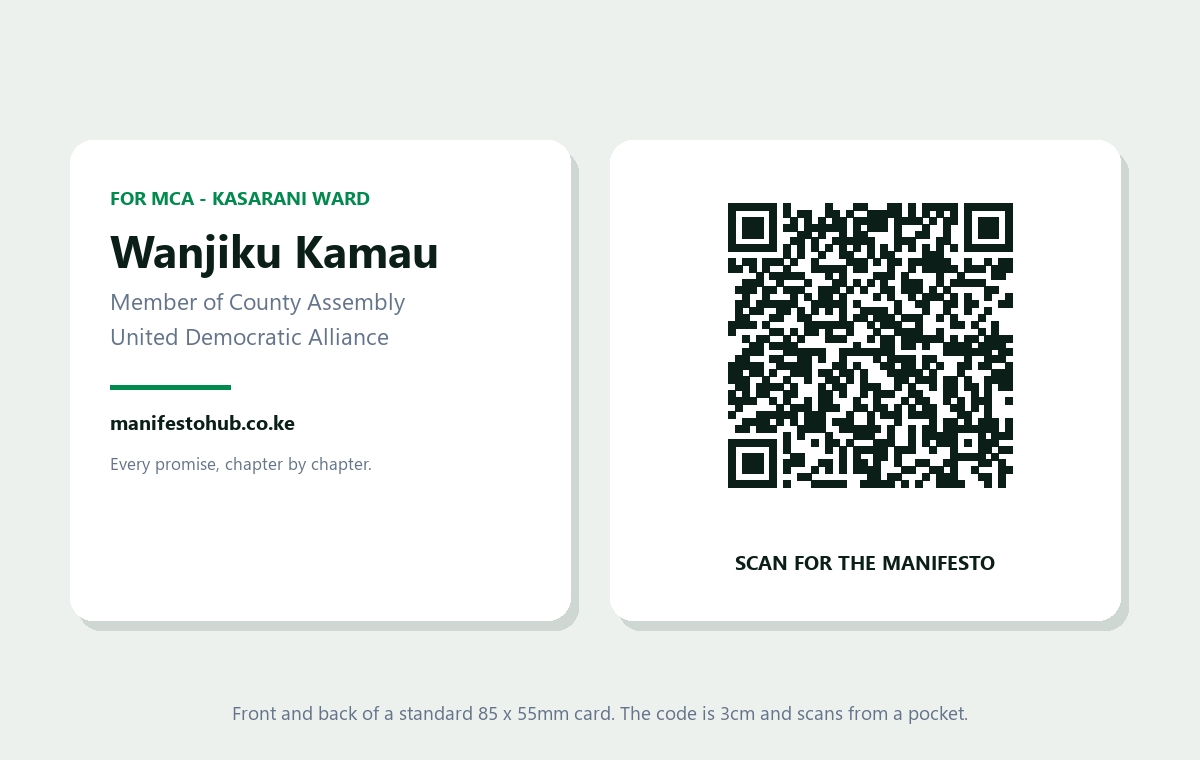
Front: name, seat, party, ward. Back: the code and the address. It is the piece of material you give away most often, and the only one somebody keeps in a pocket.

  • 85 x 55mm, the size of a bank card
  • Code at 3cm, dark on white
  • Print the address under the code
A campaign card, front and back, with a QR code on the reverse

Walls and notice boards

The A4 poster

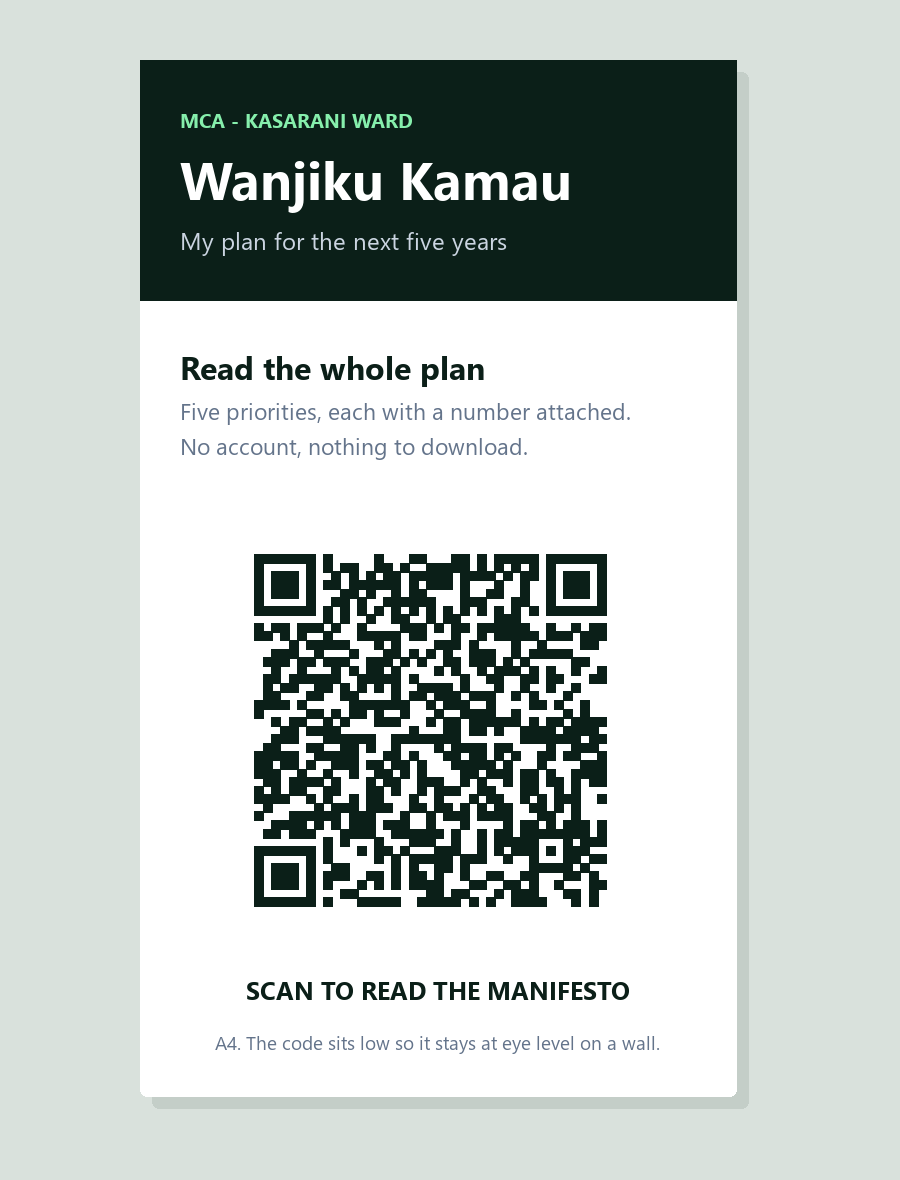
Shops, churches, school gates, the chief's office. The code goes low on the sheet so it sits at chest height when the poster is on a wall — most people will not crouch to scan.

  • A4 portrait
  • Code at 6cm or larger
  • The address in letters big enough to read at two metres
An A4 poster with the manifesto QR code at eye level

The people who wear it

T-shirts, caps and badges

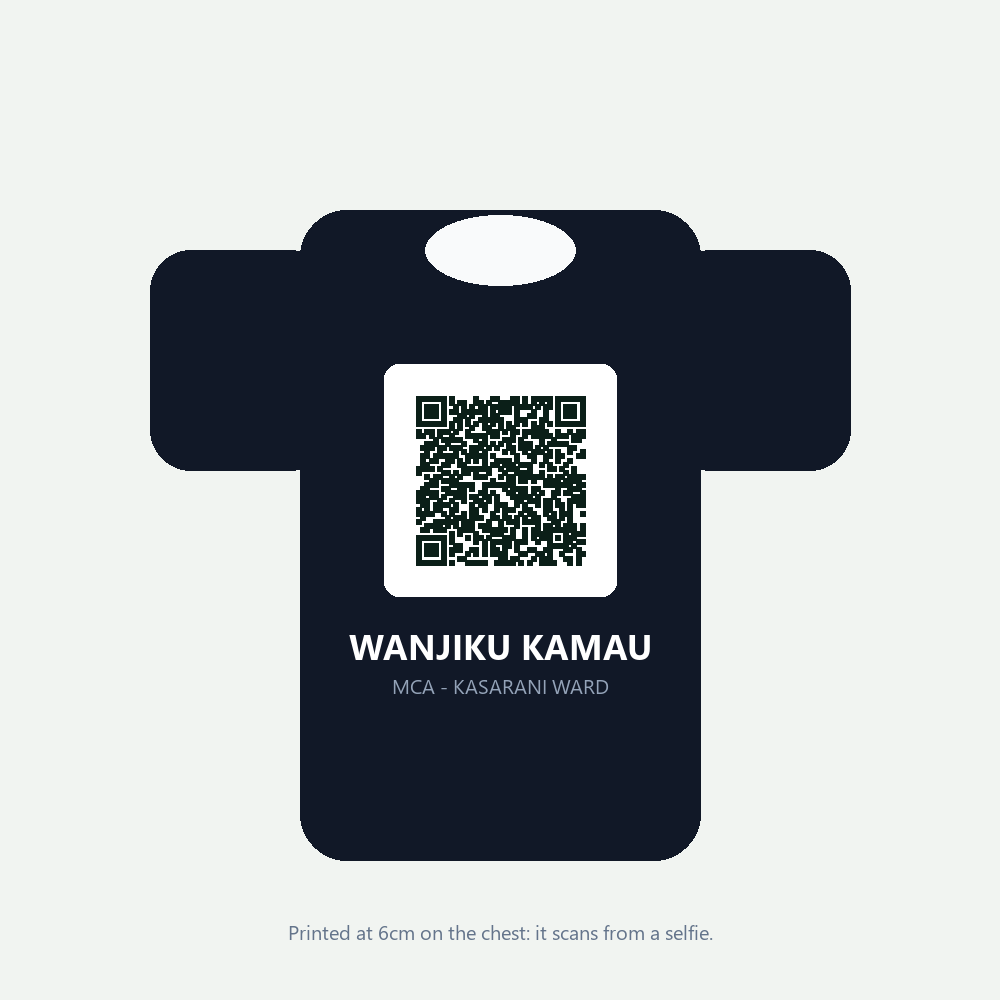
Fabric is the hardest surface: it stretches, it folds, and it is photographed constantly. The code must sit on a light panel, never printed directly onto a dark shirt, or half the phones in the crowd will refuse it.

  • Code at 6cm on the chest
  • Always a white or light panel behind it
  • Screen print, not transfer — transfers crack
A campaign t-shirt with a QR code printed on a light panel

Moving through the ward

Boda-boda and vehicle banners

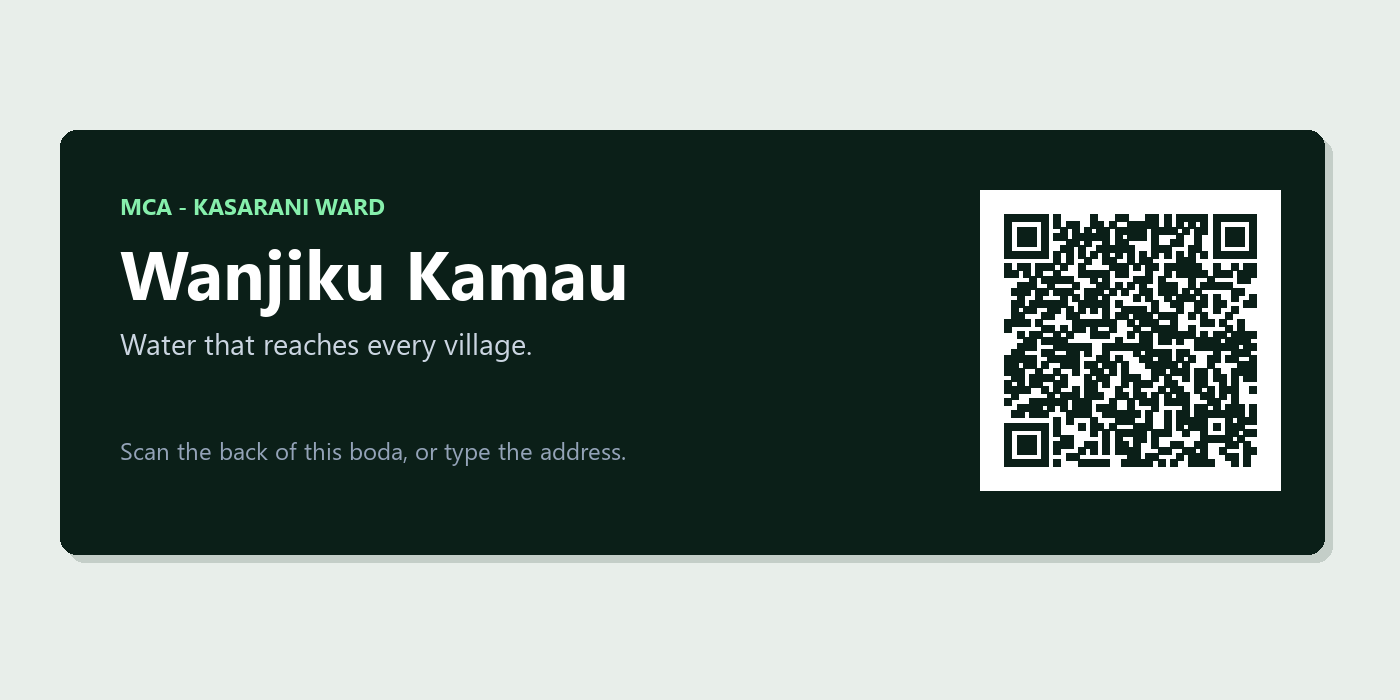
The name has to work at twenty metres, where nobody can scan anything. The code is for the market queue, when the boda is stopped and somebody is waiting.

  • Name readable at 20 metres
  • Code at 15cm on the back panel
  • Matt laminate: a glossy banner reflects the sun
A boda-boda banner with a name, slogan and QR code

Where the phone already is

WhatsApp status and social posts

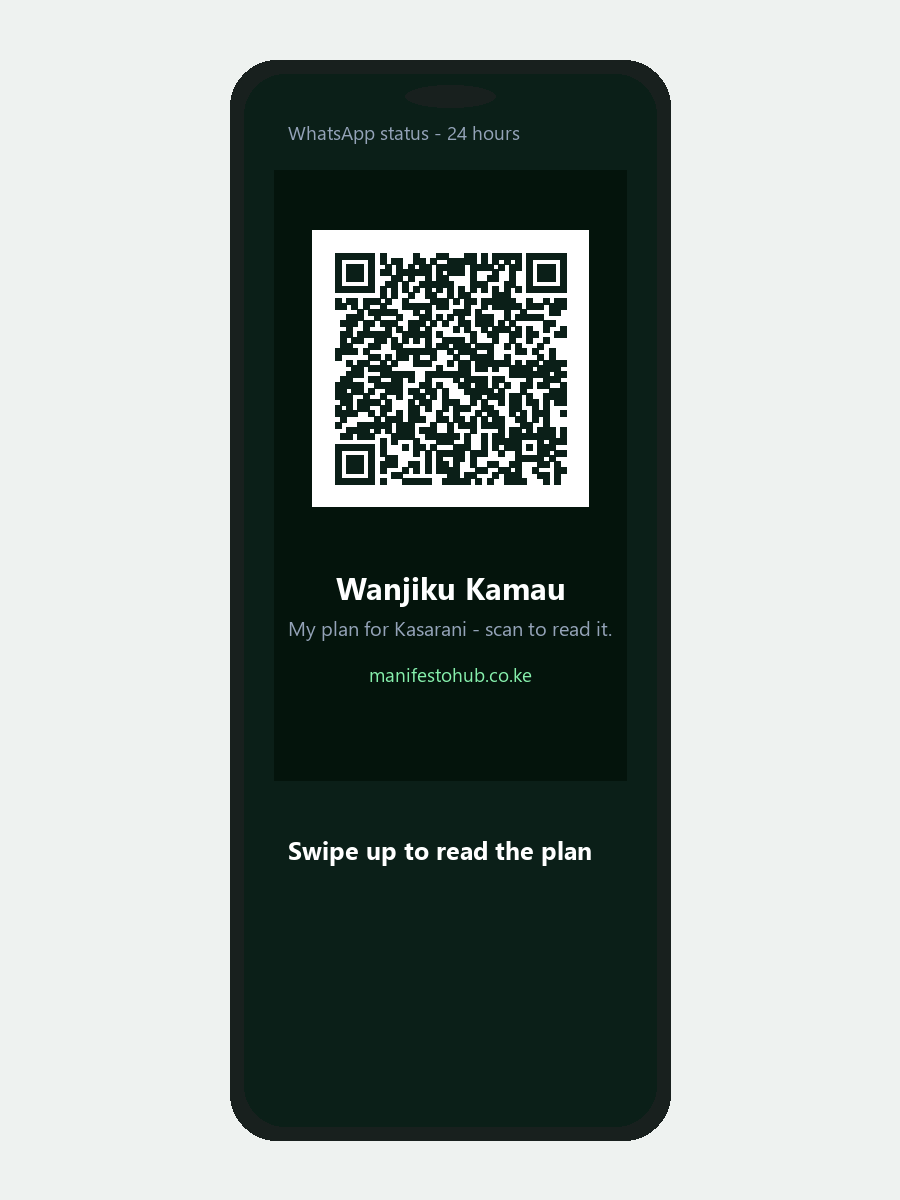
A status is seen by everyone who has your number, every day, for free. Post the code and the link together: on a phone the link is tappable, and the code is for the person who shows the screen to somebody else.

  • Square or 9:16 image
  • Link in the caption, not only in the picture
  • Ask people to forward it — that is the whole channel
A WhatsApp status card carrying the manifesto QR code and address

Small, repeated

Stickers

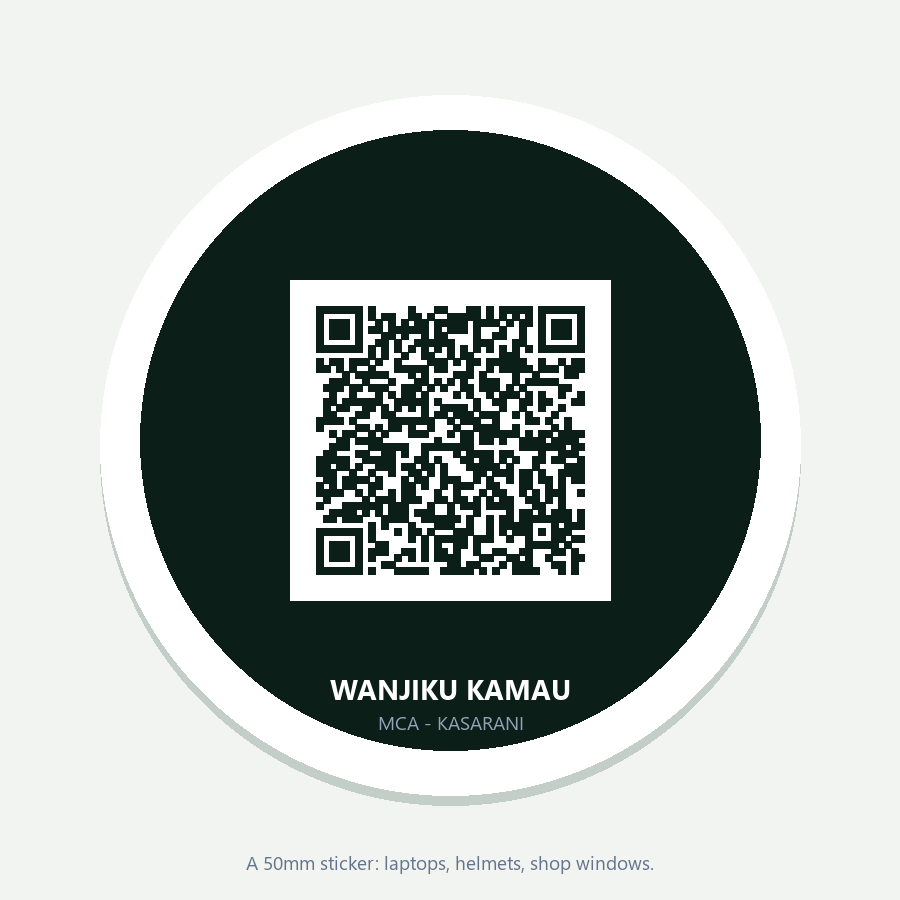
Helmets, laptops, shop windows, jerrycans. One sticker is nothing; two hundred stickers in a ward is a thing people notice twice before they scan once.

  • 50mm round
  • Code at 25mm in the centre
  • Waterproof vinyl, not paper
A round campaign sticker with a QR code

Six rules that outrank the design

01

Print the address, always.

Not everybody scans. A code with no readable address under it is a dead end for anyone whose camera will not focus, whose phone is old, or who simply prefers to type.

02

Scan the first print, not the design.

Proofs lie. Take one finished poster or shirt into the daylight and scan it with a cheap phone at arm's length. If that works, the run will.

03

Dark on light. Never inverted.

A white code on a black shirt looks better and scans worse. Phones expect dark modules on a light background; a light panel behind the code is not a compromise, it is the requirement.

04

One destination.

Point every code and every link at the manifesto, not at a WhatsApp group or a Facebook page. The manifesto is the thing you are asking somebody to read, and it does not change address when you edit it.

05

Keep the code away from the fold.

Creases, staples and folds through the middle of a code break it. Leave a clear margin and place it flat.

06

Reprint, do not re-sticker.

If your plan changes, the link stays the same — the page updates and the printed code still works. Only reprint when the design is wrong, not when the words are.

Your code is already made.

Publish the manifesto and the share kit opens: the link, a printable A4 poster, and the QR as a vector file your printer can scale to a boda-boda without pixelating it. Nothing to design, nothing to buy.